Building the next generation of collaborative Earth Observation processing
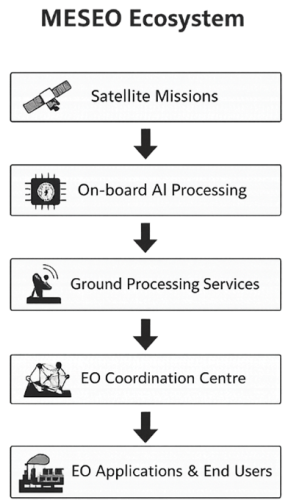
MESEO connects satellite missions, AI processing services and distributed infrastructures into a secure, scalable and sovereign Earth Observation ecosystem. The project enables faster EO processing, near-real-time services and collaborative data workflows across space and ground segments.
WHY MESEO
Why MESEO matters
Earth Observation systems are generating more data than ever before.
MESEO addresses the growing need for:
faster EO data processing,
scalable AI-powered workflows,
reduced transmission bottlenecks,
secure and sovereign data exchange,
and collaborative multi-mission ecosystems.
By combining onboard AI, geographically distributed processing and harmonised interfaces, MESEO creates a new approach for end-to-end EO services.
WHAT IS MESEO FOR
Who can benefit from MESEO?
EO Service Providers Integrate processing services and deliver scalable EO products through harmonised interfaces and distributed workflows provided by different EO Players (MESEO and no-MESEO providers).
Satellite Operators Improve onboard and ground processing performance while reducing communication bottlenecks and operational latency.
Public Authorities & Environmental Agencies Access faster EO-based services for environmental monitoring, methane emissions detection and agriculture applications. AI, Cloud & Digital Infrastructure Providers Contribute advanced AI, cloud and data processing capabilities within a trusted and sovereign EO ecosystem.
Researchers, Startups & Innovation Projects Experiment with modular EO processing architectures and collaborative services for future EO applications, demonstrating the system’s capability to seamlessly integrate new services.
MAIN OBJECTIVE
MESEO Overall Objective
MESEO is building a next-generation collaborative Earth Observation ecosystem designed to make EO data processing faster, smarter, more scalable and more secure. The project develops an open and distributed architecture that connects satellite missions, AI-powered processing services and ground infrastructures through harmonised and sovereign data workflows.
MESEO aims to:
Improve end-to-end EO service performance and responsiveness
Reduce communication bottlenecks between space and ground segments
Enable distributed and near-real-time EO data processing
Integrate AI-enhanced and energy-efficient processing technologies
Support secure and sovereign European EO data exchange
Enable collaboration between multiple EO ecosystem players through interoperable services
Optimise processing workflows dynamically using an EO Coordination Centre
Demonstrating real impact
MESEO validates its innovations through Green Deal-oriented pilot applications, including:
Methane emissions monitoring
Crop classification and agricultural monitoring
These use cases demonstrate how MESEO can improve scalability, processing speed and operational responsiveness for future EO services.
Methane Monitoring MESEO enables faster detection and analysis of methane emissions through AI-enhanced onboard processing and distributed EO workflows.
Benefits
Near-real-time monitoring
Reduced data transfer volumes
Faster response times
Support for Green Deal objectives
Crop Classification MESEO improves large-scale agricultural monitoring through distributed AI processing and multi-source EO data integration.
Benefits
Scalable crop monitoring
Faster thematic product generation
Improved resource optimisation
Better support for precision agriculture
Open to new use cases MESEO architecture is designed to support additional EO applications and external processing services.
Potential future applications include:
disaster management,
climate monitoring,
maritime surveillance,
land monitoring,
and smart agriculture services.
Interested in collaborating with MESEO? Contact us.
HOW COLLABORATION WORKS
A collaborative EO ecosystem
MESEO allows EO stakeholders to contribute:
processing services,
AI capabilities,
data sources,
and infrastructure resources through harmonised and secure interfaces.
The EO Coordination Centre dynamically orchestrates distributed services to create the most efficient processing workflow for each user request.