Connecting satellites, data, intelligence and users through a federated Earth Observation ecosystem.
MESEO
Building a Federated Earth Observation Ecosystem
Earth Observation is evolving from isolated mission-specific infrastructures towards collaborative ecosystems where multiple missions, processing services and data providers operate seamlessly together.
MESEO introduces an innovative framework that turns this vision into an operational reality.
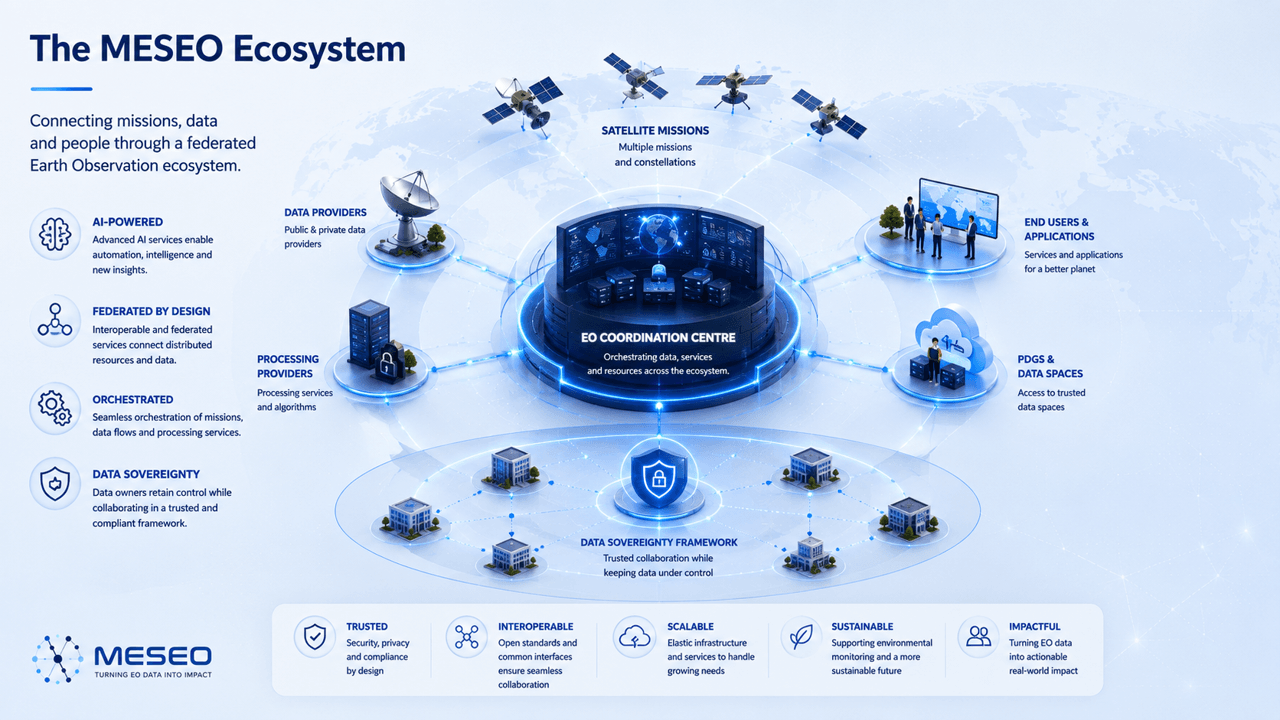
At the centre of the ecosystem is the Earth Observation Coordination Centre (EOCC), an intelligent orchestration layer that connects satellite missions, ground infrastructures, processing services and external data providers within a single federated environment.
Instead of interacting with individual missions or processing chains, users access Earth Observation capabilities through a unified service-oriented environment. The complexity of distributed infrastructures is hidden, allowing the system to automatically orchestrate data sources, processing functions and computational resources to efficiently deliver the requested products.
MESEO combines distributed processing, AI-enabled services, Function-as-a-Service principles and Data Sovereignty mechanisms to enable secure collaboration while allowing each organisation to preserve full operational independence and control over its assets.
The result is a more flexible, scalable and trusted Earth Observation ecosystem capable of supporting future multi-mission services and accelerating the delivery of high-value EO products. This concept is directly aligned with the project’s objective of promoting a collaborative digital ecosystem enabled by an EO Coordination Centre and distributed processing functions that can execute across space and ground segments while preserving data sovereignty.
How MESEO delivers value
The MESEO ecosystem turns this overall vision into operational Earth Observation services through five complementary functions: coordination of missions and services, distributed execution of processing functions, multi-mission federation, policy-based data sovereignty and AI-enabled processing.
The four technical pillars are presented in the Key Enabling Technologies section, while the concrete prototypes, products and project outcomes are presented in the Results section.