
MESEO at the Museum: From Meteorites to Artificial Satellites
Discover the wonders of space, planetary science and Earth observation at a free event for young explorers in Prato, Italy, on 25 October 2026.
How can meteorites help us understand the origins of our Solar System? And how can satellites help us discover the secrets of our planet?
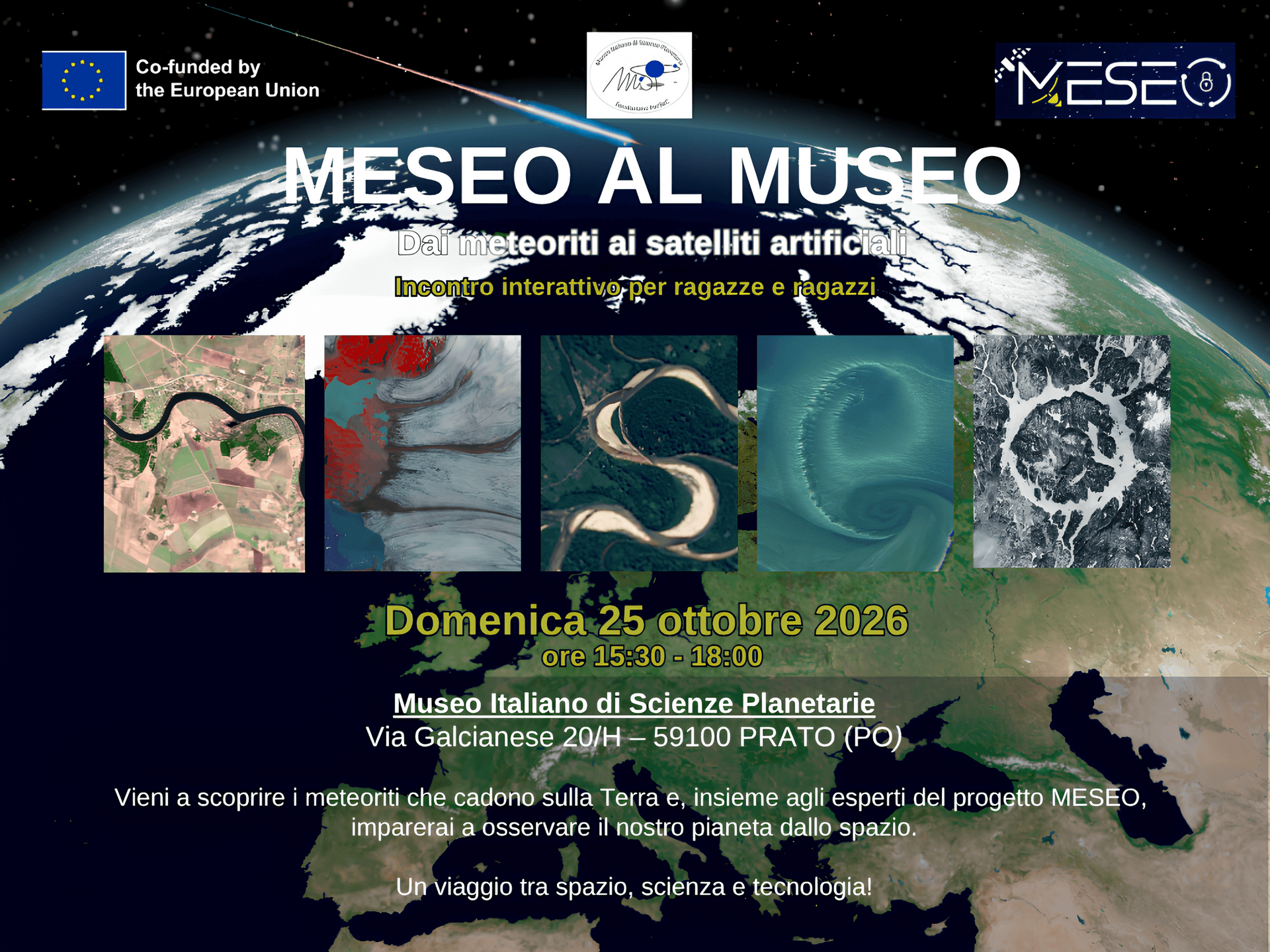
On Sunday, 25 October 2026, from 3:30 p.m., the Italian Museum of Planetary Sciences in Prato, Italy, will host “MESEO at the Museum: From Meteorites to Artificial Satellites”, a free educational event designed to introduce young people to planetary science, meteorites and the technologies used to observe Earth from space.
The event is aimed at students from the fourth year of primary school to the third year of lower secondary school.
From cosmic impacts to the origins of our Solar System
The afternoon will begin with one of the most fascinating topics in planetary science: cosmic impacts. The extinction of the dinosaurs is perhaps the most dramatic example of the effects of an impact event, while meteorites continue to reach Earth today, bringing with them valuable samples of extraterrestrial material.
Through the museum’s scientifically significant meteorite collection, participants will explore the origins and evolution of our Solar System and discover how these objects can help scientists investigate the history of our planet.
Discovering Earth from space with MESEO
The guided tour will also introduce participants to the European MESEO project, which aims to make Earth observation satellite data more efficient, faster and easier to access and use.
Through accessible explanations and engaging activities, participants will explore what satellites can see, what information can be extracted from satellite images, and how observing Earth from space can help us study our surroundings and better understand our planet.
A particularly striking example will be the Kamil impact crater, located in the desert region between Egypt and Sudan. Identified in 2008 with the help of satellite imagery, the crater demonstrates how space-based technologies can reveal geological features that are difficult to recognise from the ground.
From satellite images back to the museum collections, the journey will continue through meteorites, fossils, rocks and crystals, connecting observations from space with the evidence preserved on Earth.
An afternoon of discovery and hands-on activities
The programme will include a guided museum tour, an introduction to the MESEO project and an interactive workshop featuring scientific games and a meteorite treasure hunt.
At the beginning of the event, participants will also have the opportunity to experience the museum’s Quadrisfera, an immersive installation combining images, sounds and multiple projections to tell the story of our planet, from its formation to the emergence and development of life.
The event will last approximately three hours.
Free admission — booking required
The event is organised in collaboration with Resolvo, Communication Manager of the MESEO project, co-funded by the European Union’s Horizon Europe programme.
Admission to the museum and participation in all activities are free. Parents and accompanying adults will also enjoy free museum admission throughout the event. During the workshop, however, participation will be reserved for children and young people to ensure a dedicated space for the activities.
Advance booking is mandatory, as places are limited.
Date: Sunday, 25 October 2026
Time: From 3:30 p.m.
Venue: Italian Museum of Planetary Sciences, Via Galcianese 20/H, Prato, Italy
Age group: From the fourth year of primary school to the third year of lower secondary school
For information and bookings, please contact the Italian Museum of Planetary Sciences:
Email: msp@fondazioneparsec.it
Telephone: +39 0574 44771
Availability: Monday to Friday, 9:00 a.m.–4:30 p.m.
Find out more about the MESEO project and join us for an afternoon exploring the connections between meteorites, satellite technology and our planet.
- RESOLVO
- October 16, 2026
- 12:21 pm