

SISTEMA showcases MESEO's AI-Based Methane Detection Use Case at IWGGMS-22
The MESEO project was showcased at the 22nd International Workshop on Greenhouse Gas Measurements from Space (IWGGMS-22), held in Bonn, Germany, from 29 June to 2 July 2026.

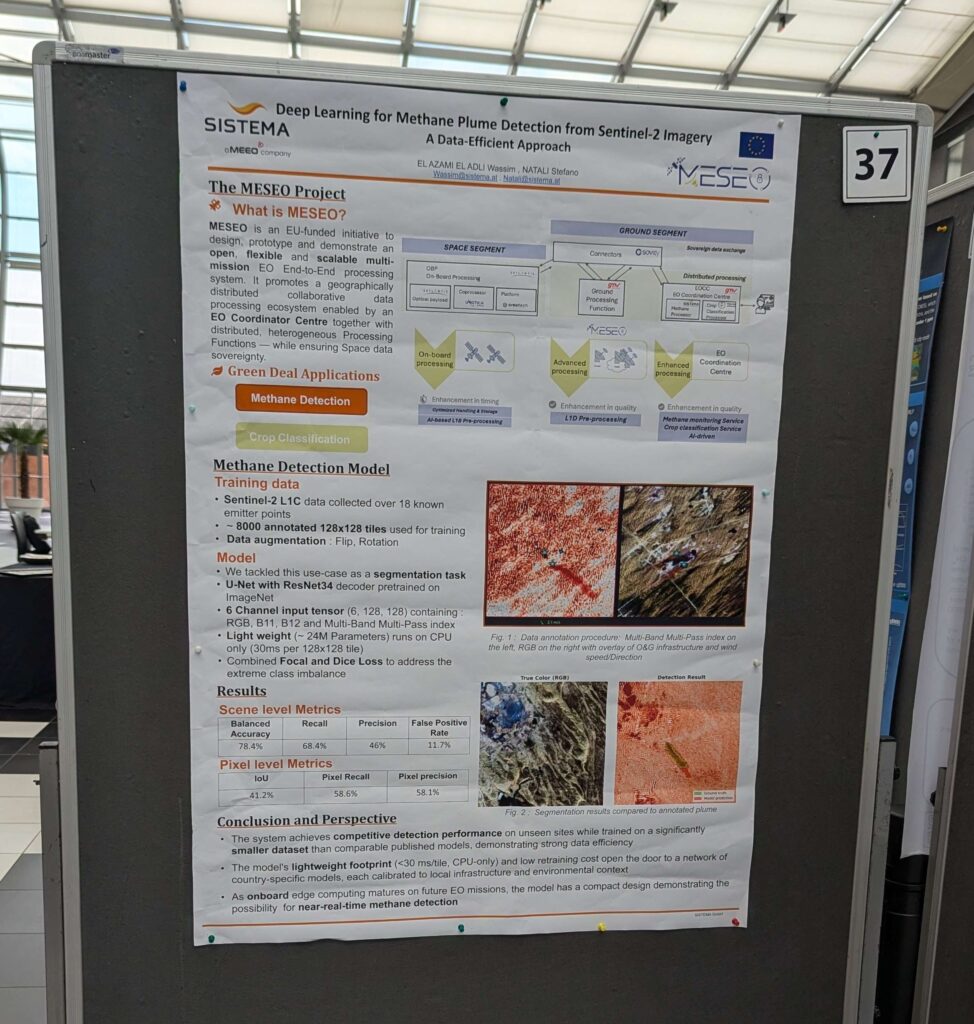
During the event, SISTEMA, the MESEO project partners responsible for the “EO for Methane Detection and Assessment” use case, presented the poster “Deep Learning for Methane Plume Detection from Sentinel-2 Imagery: A Data-Efficient Approach” in the session “Retrieval Algorithms, Priors and Products.”
The workshop brought together researchers, space agencies, Earth Observation experts and industry representatives to discuss the latest advances in satellite-based greenhouse gas monitoring, providing an excellent opportunity to present MESEO’s progress and exchange ideas with the international EO community.
Supporting Climate Action through Earth Observation
Methane is the second most significant greenhouse gas, responsible for around 30% of global warming since pre-industrial times (IEA, 2025). Detecting and mitigating large methane emissions is therefore one of the fastest and most cost-effective climate actions available today.
Within MESEO, SISTEMA is developing an Earth Observation solution that combines physics-based methane retrieval techniques with an AI model specifically optimised for small-dataset training, to automatically detect methane plumes in satellite imagery acquired by the Copernicus Sentinel-2 mission.
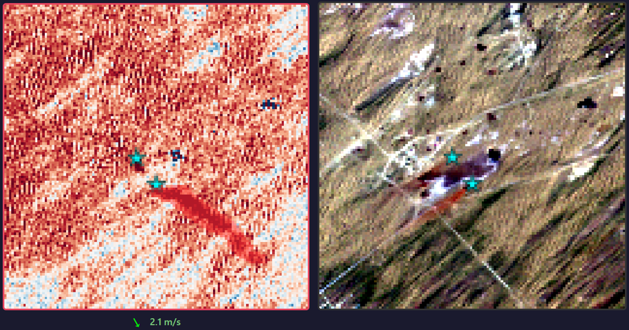
The approach first extracts methane enhancement signals using the Multi-Band Multi-Pass (MBMP) method and then applies a deep learning model capable of identifying and segmenting methane plumes with minimal human intervention. The model has been trained using carefully annotated Sentinel-2 imagery over active oil and gas infrastructures in Turkumenistan. The annotation process combined multiple complementary information sources, including methane enhancement maps, true-colour RGB imagery, ERA5 wind fields, and infrastructure location data, enabling the creation of a high-quality reference dataset for AI training and validation.
Promising results
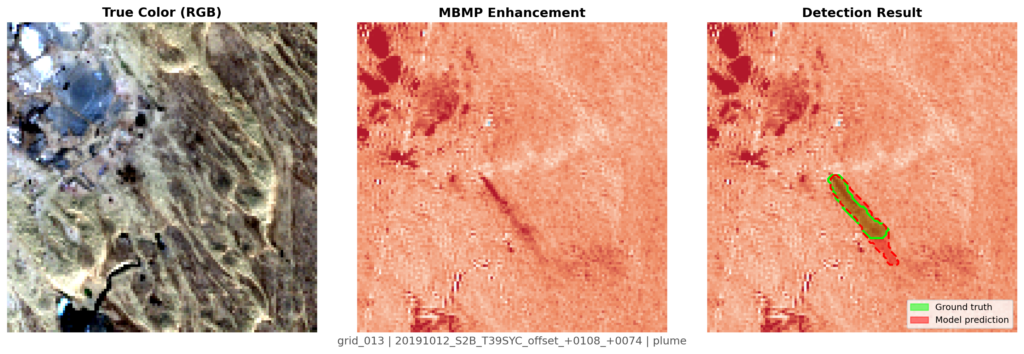
Initial validation demonstrates encouraging performance on satellite imagery from geographic locations never seen during training. Despite being trained on a relatively small annotated dataset compared with other published approaches, the model achieves a balanced accuracy of 78.4%, a false positive rate of 11.7%, and a pixel-level Intersection over Union (IoU) of 41.2%.
An important advantage of the proposed solution is its operational efficiency. The lightweight AI model can process a Sentinel-2 tile in less than 30 milliseconds on a standard CPU, without requiring dedicated GPU hardware. As a result, an entire Sentinel-2 scene covering approximately 100 × 100 km can be screened in under one minute, making the system well suited for large-scale operational monitoring. The model’s compact design also represents a step toward smaller, more efficient architectures that, with further development, could eventually support on-board satellite processing as edge-computing hardware for space applications continues to mature.
Strong interest from the Earth Observation Community
The poster generated significant interest among workshop participants, particularly regarding MESEO’s scalable and modular architecture and the methane detection work presented, which focused on optimising model size and training complexity for constrained-data settings. The discussions also highlighted the value of the high-quality reference dataset created within MESEO and its potential to support future research, algorithm development, and benchmarking activities beyond the project’s lifetime.
SISTEMA had the opportunity to exchange ideas with representatives from organisations including KNMI, EUMETSAT and Google, highlighting the growing interest in operational AI solutions for greenhouse gas monitoring and and reinforcing the relevance of the technologies being developed within MESEO.
Looking ahead
The work presented at IWGGMS-22 represents an important milestone for the MESEO methane detection use case. The next phase will focus on packaging the methane detection model as a standalone Docker processor and integrating it into the MESEO end-to-end demonstration platform, where it will operate alongside the project’s crop classification services and other Earth Observation components.
By combining advanced Artificial Intelligence with Copernicus Sentinel-2 data, MESEO is contributing to the development of efficient, scalable, and operational Earth Observation solutions that support environmental monitoring and climate action.
- SISTEMA
- July 28, 2026
- 12:30 am