Methane is the second most potent greenhouse gas, responsible for nearly a third of global warming observed since pre-industrial times. A significant portion of methane emissions come from a small number of large point sources at oil and gas facilities. Identifying these sources from space is one of the fastest and most cost-effective ways to reduce emissions, Sentinel-2’s bands in the shortwave infrared make detection possible but challenging. Automated systems are needed to screen vast areas of satellite imagery and flag emission events for rapid response.
MESEO’s Approach
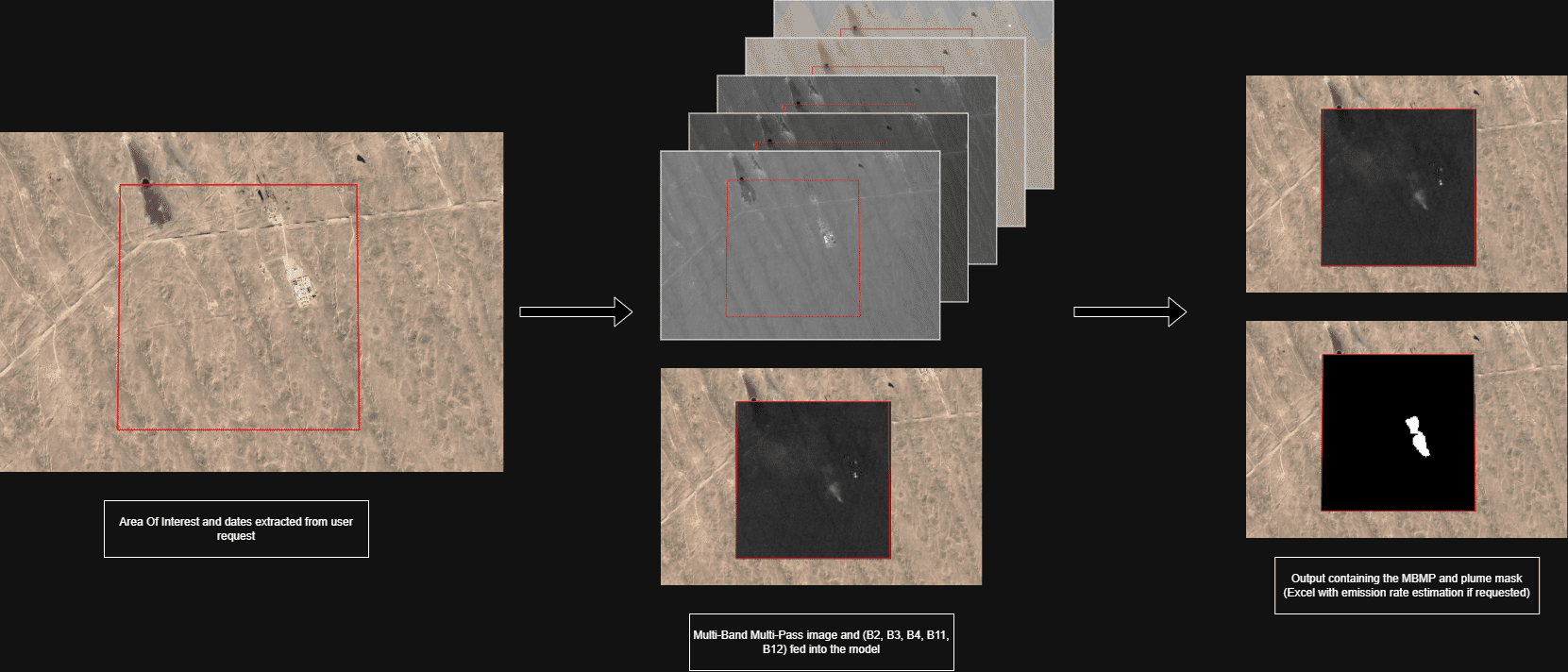
The methane processor was designed with operational integration in mind. The processing chain combines physics-based retrieval with deep learning in a lightweight architecture that requires only standard CPU hardware, enabling systematic screening of large areas at minimal computational cost. Containerised deployment ensures seamless integration within existing Earth Observation workflows such as the MESEO end-to-end environment.
Figure 1: Simplified processing chain from user request to output
Technologies Involved
The service leverages Sentinel-2’s free and open multispectral imagery with a 2–5 day revisit cycle, the Multi-Band Multi-Pass (MBMP) methane retrieval method for extracting methane signals from shortwave infrared bands, a deep learning segmentation model trained on expert-annotated satellite data and optimized to deal with the small and unbalanced available data, ERA5 reanalysis wind fields for emission rate estimation, and Docker containerisation for scalable cloud deployment, orchestrated by Prodigi®.
Demonstrated Results
The trained model was validated over oil and gas infrastructure in Turkmenistan using Sentinel-2 imagery. It correctly detects methane plumes with a balanced accuracy of 78.4% and a false alarm rate of 11.7%. For large emission events detection. The AI model is lightweight and runs on standard hardware without GPU. The Methane detection processor has been integrated and demonstrated within the MESEO end-to-end environment.
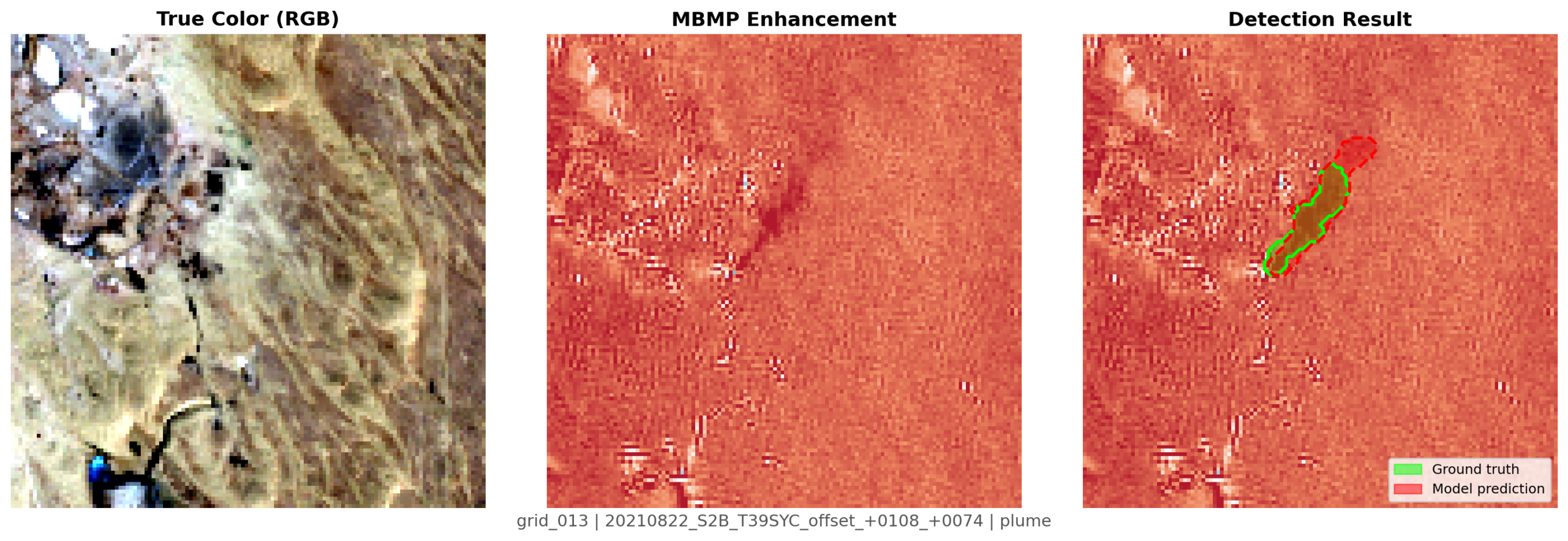
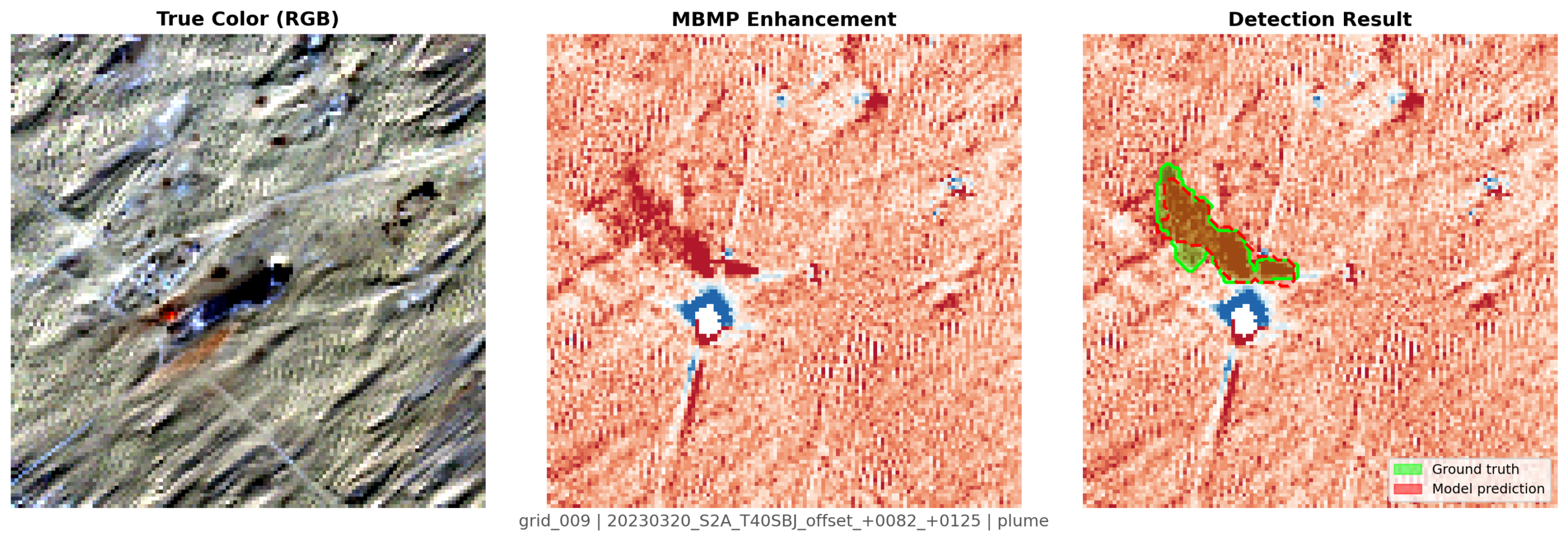
The examples below show the model output (red) compared with expert annotations (green) over Sentinel-2 scenes in Turkmenistan.
Figure 2: Detected plume (red) vs expert annotation (green) on a complex background, Sentinel-2, August 2021.
Figure 3 : Detected plume (red) vs expert annotation (green) near an active flare, Sentinel-2, March 2023.
Future Exploitation
The methane detection capability developed within MESEO is positioned to address the growing demand for satellite-based emissions monitoring driven by the EU Methane Regulation. Post-project, the processor will be maintained and further developed by SISTEMA as a commercial service offering, with planned improvements including enhanced detection sensitivity and extension to additional geographical areas of interest.
AI-Powered Methane Detection
Methane monitoring represents an increasingly important application of satellite Earth Observation.
MESEO has developed an AI-based ground processing capability designed to identify potential methane emissions from satellite imagery.
The technology offers opportunities for scalable monitoring services supporting environmental organisations, energy-sector operators and other stakeholders involved in emissions management.
Future activities will focus on improving processing performance, extending geographic coverage, validating the technology with potential users and developing service offerings.
Potential applications include automated detection alerts, emissions monitoring and support for environmental assessment activities.